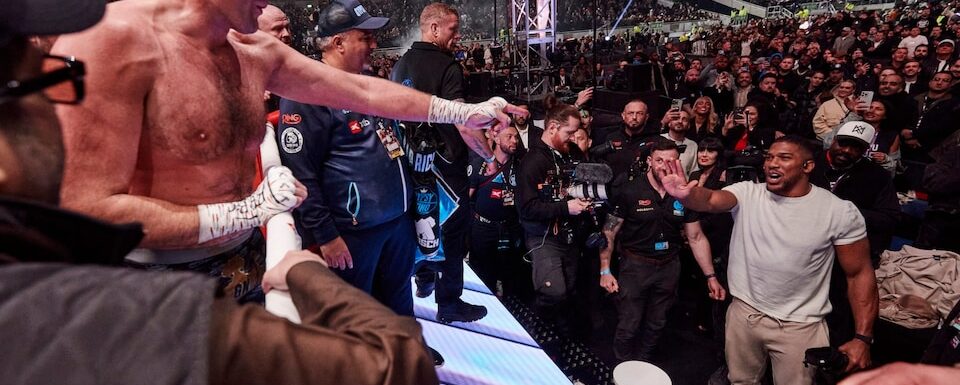
“I want you, AJ,” Fury bellowed into the microphone. “Let’s give the fans what they want. The Battle of Britain. Ten years in the making – let’s finally dance.”
It was a moment of sporting theatre, delivered as though this was the next chapter of a WWE saga. But as the crowd roared, Joshua remained calm. When the microphone was finally thrust into his hand, the boxer who once held three of the four major world titles was far from conciliatory. It was an awkward moment.
“You’re a clout-chaser, Tyson,” Joshua retorted, his voice calm and determined, clearly not reading the room, or keeping to the script. “I’ll have you in the ring when I’m ready. I’m the landlord here. You work for me.”
He would not be bullied into stepping into the ring to face-off.
It is understood that both sides have been negotiating their deals separately with the Saudi Arabians since last year, the Riyadh Season organisers having been instrumental in putting on the biggest fights since October 2023.
But in the mind of Joshua, he has clearly not accepted the fight yet.
The landscape changed for him late last year and Joshua is a man rebuilding more than just a boxing career. His absence from the ring in early 2026 was born of a personal tragedy far greater than any sporting loss after a devastating car accident in Nigeria that claimed the lives of two close friends. Joshua is clearly still grappling with the emotional toll.
Yet, despite his insistence that he is “the boss”, time is the one opponent neither man can outpace. Fury is 37, Joshua is 36. The window for this era-defining clash is closing.
Joshua lost in 2024 to Daniel Dubois, fought Jake Paul last December in a circus fight, and may require a warm-up. Joshua will not have seen major concerns in the Fury performance. This was not the vintage, fleet-footed Fury who danced around Wladimir Klitschko in Dusseldorf in 2015, nor was it the destructive force that dismantled Deontay Wilder in Las Vegas.
Instead, in his first outing in 16 months, we saw a man showing the inevitable rust of a 37-year-old heavyweight.

For the boxing purist, this Fury-Joshua dance has become a wearying marathon of “will-they, won’t-they”. We have been here before – in 2021, in 2022, and again last year. Each time, the biggest and most lucrative British blockbuster ever, worth an estimated £200m in purse alone, has evaporated into a cloud of litigation, ego and terms and conditions.
Promoter Eddie Hearn has hinted at a summer return for Joshua, perhaps against Deontay Wilder, to test the engine before diving into the Fury deep end. It is a logical, promoter-led strategy.
But logic has no place in the pantheon of great British rivalries. We do not need another tune-up. We do not need another tactical masterclass against a fading American heavyweight.
What the sport – and British fans – demand is the resolution of a decade-long argument. Fury, for all his flaws and his frustrating periods of retirement, remains the most natural talent of his generation. His performance against Makhmudov was far from flawless – he looked vulnerable, his timing was occasionally awry – yet his ring IQ remains a level above almost everyone else.
The shadow of Alalshikh looms large over this saga. The Saudi influence has transformed the boxing economy, making seemingly impossible fights suddenly inevitable. That has been the case for two and a half years. If anyone can bridge the chasm between the egos of Team Fury and Team Joshua, it is the architects of the Riyadh Season.
The plan, as it stands, is a collision in late 2026, probably between September and December. But in boxing, a week is a lifetime. An injury in sparring or a slip-up in a warm-up fight could rob us of the only heavyweight fight that truly matters to British fans.
This is not just about belts any more. Both men have been champions; both have tasted the bitter dregs of defeat. This is about history. It is about whether we will look back on this era of British heavyweights as a golden age that actually delivered, or a series of what ifs discussed in bars and pubs by the fight-following cognoscenti.
Fury has laid down the gauntlet. He has shown he is willing to be vulnerable to get the fight made. Joshua is holding the keys, waiting for the right price and the right moment. But the fans are tired of the preamble. The contracts must be signed. The dates must be set.
Whether it is under the lights of Wembley Stadium, in Dublin, as has been suggested in the last week, or the desert sun of Riyadh, the time for talking is over. Fury and Joshua, Joshua and Fury, whoever the A-side is, must fight. Not for the money, not for the clout, but for the simple, brutal truth of who is the best of their generation.
Fury is ready. He went even further after the fight, insisting that if it is not Joshua who fights him next, he is done with the sport. It is time for Joshua to step onto the canvas and engage in the long-running British sporting saga and have the last great dance with the Gypsy King. It is now, or never.
The subplot to the night was whether the great dance between Fury and Joshua would finally happen.
Netflix, the broadcasters, had little doubt it will take place, officially announcing the fight via social media.